Swept Away by Pride

Isaiah’s list of cities proclaimed for downfall concludes with the cities of Tyre and Sidon, merchant centers for ancient Phoenicia. This country, to which we owe the alphabet, becomes bound in persistent pride and arrogance in their worship of false gods. It will mean their destruction.

Pride is at the head of all sin—a deadly hurricane that sweeps destruction in its path. Continue the selfexamination suggested in yesterday’s approach to “The Parable of the Wheat and the Tares.” Allow the power of the Holy Spirit to sweep through you and make your house clean with the strong winds of the Spirit.

Is worship and dedication to God and God’s will absolutely at the center of your inner house? If it is not, your house is one built on the fickle, shifting sands of the world; the winds will blow it away.

Isaiah 23

Mondays are dedicated to the reading of the Hebrew Prophets.
In the season of Pentecost this year we read Isaiah 13 – 27; Lamentations 1 and 2 in the Ninth Week.

What are “Bible Breaths”? Learn More…
Example: Being still, for You are God v. 2

For all the Firestarters I recommend the ebook.  You will have the entire program of well over a thousand of these introductions with you on your phone or tablet. Check the menu options at the site for more information.
Wheat for the Bread

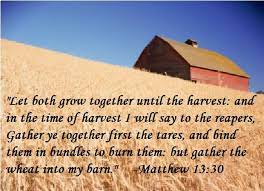
There is a basic point in “The Parable of the Wheat and the Tares.” It is difficult to distinguish between weeds and wheat. Lest there be any wheat killed by “friendly fire,” Jesus invites us to hold back. Discernment about good and evil is a gift we need from the Spirit; yet Jesus admonishes us not to judge. There is a time and place for judgment and for the eternal separation of the good from the bad, but it is not now, and it is not for us to judge; this is reserved for God at the end of time.

There is still time for you and me! This suggests another interpretation: “tare-like” qualities in a person can be transformed into wheat! Yet another point of the parable: it discourages living in someone else’s head, instead of in your own. Self-examination, rather than the examination of others, is what will have what is “tare-ible” in you, become wheat for Christ’s bread.

Matthew 13:24–30; 36–43

What are “Bible Breaths”? Learn More…
Example: Weeds and wheat till the harvest v. 29

Sundays are dedicated to the Gospels from the Revised Common Lectionary.
During the Seasons of Pentecost and Kingdomtide, we read the Gospel of Matthew.


For all the Firestarters I recommend the ebook.  You will have the entire program of well over a thousand of these introductions with you on your phone or tablet. Check the menu options at the site for more information.

Like Samuel or Saul 

As gears out of sync in a machine, so are Saul and the Israelites. Decisions are made apart from prayer; rather they are impetuous reactions, prompted by fear, power and pride.

Alone among them completely doing the Lord’s will, is Samuel. Listen to him once again say to the people as he said to God as a boy, “Here I am” (12:3). His transparency to God makes him able to be used by God. Nothing is between him and his Lord. He lives uncontaminated by the evils that enter and gradually push their way deeper and deeper into Saul, disconnecting his heart from the Lord. Samuel, on the other hand, always holds God’s people in prayer.

Discern those inner movements that make for oneness with the Lord and those that disrupt and break away from God. As you listen to the promptings of the Spirit, are you like Samuel or Saul?

1 Samuel 11—13

What are Bible Breaths? Learn More…
Example: Turning not to useless things12:21

Tuesdays are dedicated to the Old Testament books of history
and the Hebrew “Writings.”
In the season of Pentecost this year we read Proverbs 13 and 14 and 1 Samuel.


For all the Firestarters I recommend the ebook.  You will have the entire program of well over a thousand of these introductions with you on your phone or tablet. Check the menu options at the site for more information